
Cold Chain Management UAE Supermarket: From Receiving Dock to Display
11 مايو 2026
Imagine walking into a supermarket, picking up a fresh piece of salmon, and trusting — with absolute confidence — that it has been properly chilled from the moment it left the processing plant. That trust isn’t magic. It’s the result of a meticulously engineered system known as cold chain management UAE supermarket operations depend on every single day. In the UAE, where temperatures outside can exceed 45°C in summer and food safety regulations are among the strictest in the region, getting the cold chain right isn’t optional — it’s existential.
Across the Emirates, retail food businesses face a unique convergence of challenges: extreme ambient temperatures, a highly multicultural consumer base with diverse food expectations, and a regulatory environment enforced by the Food Safety Authority UAE that leaves zero room for error. A single cold chain failure can result in spoiled stock worth thousands of dirhams, regulatory fines, reputational damage, and — most critically — harm to consumers.
This comprehensive guide walks you through every stage of cold chain management UAE supermarket professionals must master: from the critical moment produce arrives at the receiving dock, through storage and inventory management, all the way to the display case where customers make their purchasing decisions. Whether you’re opening a new supermarket, upgrading an existing one, or simply tightening your food safety compliance, this article is your definitive reference.
What Is Cold Chain Management? A UAE Supermarket Definition
Before diving into the mechanics, it’s worth establishing a clear definition. Cold chain management UAE supermarket operations refers to the end-to-end process of maintaining temperature-controlled environments for perishable goods — from point of origin or delivery through storage, display, and ultimately to the consumer’s hands. Every link in this chain must remain unbroken; a single gap can compromise the entire product.
In the UAE context, the cold chain encompasses refrigerated transport vehicles, receiving temperature logs at dock entry, walk-in chillers, cold storage rooms, display refrigeration cases, and even the customer’s journey to their car. The chain is only as strong as its weakest link, and in the UAE’s heat, that risk is amplified at every transition point.
read more : How to Open a Supermarket in Dubai (Open Supermarket Dubai License Explained)
Why Cold Chain Failures Are Catastrophically Costly in UAE
The cost of cold chain failure is multidimensional. In 2024 alone, the UAE food retail sector reported significant losses attributed to temperature mismanagement — with fresh produce, dairy, and seafood bearing the highest risk. Beyond direct stock loss, businesses face:
• Regulatory penalties from ADAFSA, Dubai Municipality, and other Food Safety Authority UAE bodies
• Customer trust erosion that can permanently affect footfall
• Legal liability if contaminated food causes illness
• Brand damage that takes years to recover from in a competitive market
Understanding these stakes is what motivates the world-class cold chain management UAE supermarket operators to invest seriously in infrastructure, training, and monitoring systems.
Stage 1: The Receiving Dock — Where Cold Chain Management UAE Supermarket Operations Begin
Everything starts at the receiving dock. This is the single most critical control point in the entire cold chain management UAE supermarket system. Products arriving from suppliers may have experienced temperature abuse during transit — and without rigorous inspection at this stage, compromised goods enter your facility and your supply chain.
Maintaining Accurate Receiving Temperature Logs
The foundation of receiving dock management is the receiving temperature log. Every incoming delivery — whether it’s chilled meat, frozen vegetables, or dairy products — must be temperature-checked immediately upon arrival, before the delivery is accepted. This isn’t merely a best practice; it’s a legal requirement under UAE food safety regulations.
A proper receiving temperature log should capture: product name, supplier name, delivery time, ambient temperature at dock, internal product temperature (measured with a calibrated probe thermometer), vehicle temperature (checked from the vehicle’s own recorder), lot number or batch code, and the receiving staff member’s name and signature. These logs must be retained for a minimum period as specified by your local food authority.
Best-in-class supermarkets in the UAE are now moving to digital receiving temperature logs using tablet-based systems that timestamp entries automatically, flag out-of-range temperatures with alerts, and sync data to a cloud dashboard for management review. This eliminates the human error risk of paper logs and creates an immutable audit trail.
Temperature Acceptance Criteria by Product Category
Not all products share the same acceptance thresholds. Your receiving team must know — by memory and by posted reference charts — the acceptable temperature bands for each category:
| Product Category | Max Acceptance Temp | Rejection Threshold | Notes |
| Fresh Meat & Poultry | 4°C | >5°C | Check core temp |
| Seafood / Fish | 0–2°C | >4°C | Ice should be present |
| Dairy (Milk, Cheese) | 4°C | >6°C | Check use-by date |
| Frozen Products | -18°C | >-15°C | No frost/thaw signs |
| Fresh Produce | 4–8°C | >10°C | Varies by product |
| Deli / RTE Foods | 4°C | >5°C | High-risk category |
Rejected Deliveries: Protocol and Documentation
When a delivery fails temperature inspection, the receiving team must immediately initiate the rejection protocol: clearly mark the goods as rejected, isolate them from accepted stock, document the rejection in the receiving temperature log, photograph the temperature reading and the products, notify the supplier, and file a non-conformance report for your records. Never accept borderline products under time pressure — the short-term convenience is never worth the long-term risk.
👉 Browse Commercial Refrigeration & Coldline Equipment — Explore our full range of supermarket-grade refrigeration solutions for UAE cold chain compliance
Stage 2: Cold Storage — The Heart of Cold Chain Management UAE Supermarket Facilities
Once products pass receiving inspection, they enter cold storage — the climate-controlled backbone of your cold chain management UAE supermarket operation. Proper cold storage design, organization, and maintenance directly determines shelf life, food safety outcomes, and operating costs.
Walk-In Chillers: Design and Temperature Zoning
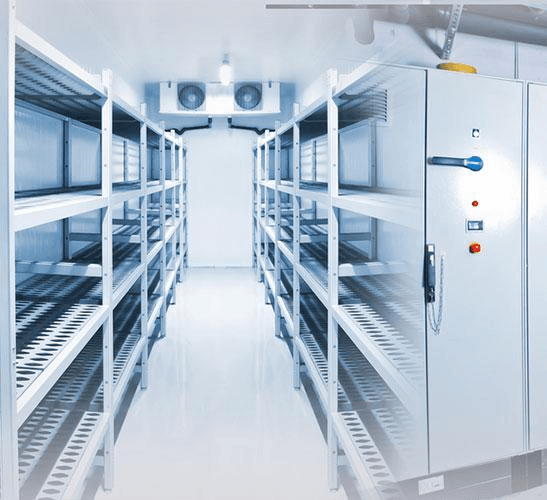
UAE supermarkets typically operate multiple cold storage units: walk-in chillers for fresh produce and dairy, walk-in freezers for frozen goods, blast chillers for rapid cooling of hot-prepared foods, and dedicated units for high-risk categories like seafood and raw meat. Each must maintain its prescribed temperature band consistently — and independently.
Temperature zoning within storage is critical. Raw meats must never be stored above ready-to-eat products. In the vertical hierarchy of a walk-in chiller: whole raw fish and seafood on the lowest shelf, raw ground meat above that, raw whole cuts of meat next, followed by raw poultry, then eggs and dairy, and finally ready-to-eat foods, deli items, and produce at the top. This isn’t aesthetic preference — it’s cross-contamination prevention mandated by Food Safety Authority UAE guidelines.
The FIFO Rotation System: Your Freshness Guarantee
The FIFO rotation system — First In, First Out — is the cornerstone of inventory management in any cold storage environment. The principle is simple but its execution requires discipline: products that arrive earlier must always be used or sold before those that arrived later. Every time new stock enters storage, it goes to the back; existing stock moves forward.
In practice, a rigorous FIFO rotation system means: dating all incoming stock with clear, visible labels upon receipt; organizing shelving so the oldest product is always at the front and most accessible; training every member of the storage and floor team to respect FIFO without exception; and conducting regular stock checks to identify any product that may have been bypassed and is approaching or past its use-by date.
The FIFO rotation system is particularly critical in the UAE market where delivery schedules may not always be consistent, and where peak seasons — particularly Ramadan — can cause significant fluctuations in stock levels and turnover rates. A well-implemented FIFO approach can reduce food waste by up to 30% while simultaneously improving food safety scores.
Compressor Maintenance: The Lifeline of Your Cold Chain
The most sophisticated temperature monitoring system in the world is worthless if your compressors fail. Compressor maintenance is not optional maintenance — it is mission-critical infrastructure care. In the UAE’s extreme heat, refrigeration compressors work harder than anywhere else in the world, running at near-maximum capacity during summer months. This accelerates wear and increases the risk of failure.
A comprehensive compressor maintenance program for a UAE supermarket should include: weekly visual inspections of condenser coils for dust and debris buildup (the UAE’s sandy environment is particularly aggressive), monthly refrigerant level checks, quarterly professional servicing including belt tension, motor amperage testing, and evaporator coil inspection, and annual deep-service including full refrigerant flush and system pressure testing.
Condenser coils clogged with sand and dust — a near-constant risk in UAE environments — can reduce compressor efficiency by 30–40%, dramatically increasing energy consumption and reducing cooling capacity. Regular compressor maintenance schedules, rigorously followed, prevent the cascading failures that lead to complete cold chain breakdowns during the hottest months of the year.
👉 Explore Reach-In Refrigerators for Supermarket Storage — High-performance reach-in refrigerators designed for UAE commercial environments
👉 Shop Undercounter Chillers & Freezers — Space-efficient undercounter cooling solutions perfect for supermarket back-of-house operations
Stage 3: Display Cases — Cold Chain Management UAE Supermarket Front-of-Store Excellence
The display case is where cold chain management UAE supermarket systems meet the consumer. It is also one of the most challenging temperature environments to manage consistently. Unlike closed cold storage, display cases are subject to constant opening, ambient heat intrusion from the store floor, customer interaction, and lighting heat. Getting the balance right between product visibility, accessibility, and temperature integrity is both a science and an art.
Display Case Temperature Bands: Category by Category
Understanding display case temperature bands is fundamental to compliant, effective merchandising. Different product categories require different display case temperature bands, and mixing products with incompatible requirements in a single case is a common but serious error.
| Display Case Type | Optimal Temp Band | Product Category | Key Risk |
| Multi-deck Chiller | 0–4°C | Dairy, Deli, Meat | Door-open heat gain |
| Open Produce Case | 4–8°C | Fresh Fruits & Veg | Condensation damage |
| Frozen Island | -18°C to -22°C | Ice Cream, Frozen | Loading line breaches |
| Fish Counter | 0–2°C | Fresh Seafood | Ice replenishment |
| Hot Deli Case | 60°C+ | Cooked Foods | Separate from cold |
| Wine Cooler | 8–14°C | Beverages | UV light exposure |
One of the most commonly overlooked aspects of display case temperature bands management is the ‘load line’ rule: products must never be stacked above the load line marked inside open display cases. Exceeding this line places products outside the refrigerated air curtain, exposing them to ambient temperatures that can quickly climb into unsafe zones in a busy UAE supermarket.
Open vs. Closed Display Cases: Making the Right Choice
The debate between open and closed display cases is one every UAE supermarket must resolve for their specific context. Open multi-deck cases offer maximum product visibility and customer convenience but are dramatically less energy-efficient and more temperature-sensitive. Closed cases with doors are significantly more energy-efficient and maintain temperatures more consistently — critical in the UAE — but can deter impulse purchases if customers find doors inconvenient.
The best practice adopted by leading UAE supermarkets is a hybrid approach: closed-door cases for high-value, high-risk items (premium meats, specialty dairy, deli) and open cases for high-turnover, lower-risk produce. Night blinds or curtains on open cases during closed hours can reduce energy consumption by 20–30% and help maintain temperatures during overnight periods.
Temperature Monitoring Technology for Display Cases
Modern cold chain management UAE supermarket operations rely on continuous electronic temperature monitoring systems. Wireless temperature sensors installed in display cases transmit real-time data to a central dashboard, with automated alerts sent to management phones if temperatures breach preset parameters. This allows immediate corrective action — 24 hours a day, 7 days a week — without requiring constant physical monitoring.
👉 View Supermarket Equipment by Al Razana — Complete supermarket display and refrigeration solutions engineered for UAE conditions
👉 Explore Work Top Chillers & Refrigerators — Worktop chillers ideal for supermarket deli counters and food prep stations
UAE Food Safety Authority Rules: Compliance in Cold Chain Management UAE Supermarket Operations
Operating a supermarket in the UAE means navigating a robust regulatory framework. The Food Safety Authority UAE — operating through bodies including the Abu Dhabi Agriculture and Food Safety Authority (ADAFSA), Dubai Municipality’s Food Safety Department, and equivalent bodies in each emirate — has established comprehensive standards that govern every aspect of cold chain management.
Key UAE Food Safety Regulations Affecting Cold Chain
The most operationally significant Food Safety Authority UAE requirements for supermarket cold chain include:
• Temperature record-keeping: Continuous temperature logs for all refrigerated and frozen storage units, retained for a specified period (typically 90 days minimum)
• Receiving documentation: Formal receiving temperature logs for all chilled and frozen deliveries, with supplier documentation retained
• Equipment calibration: All temperature-measuring devices must be calibrated at regular intervals with calibration records maintained
• HACCP implementation: Hazard Analysis and Critical Control Points must be documented and followed, with cold chain control points formally identified
• Staff training: All food handling staff must hold current food safety certificates; training records must be maintained
• Pest control records: Regular professional pest control with documented visits and findings
• Product traceability: Ability to trace any product back through the supply chain within 24 hours
Preparing for Food Safety Inspections in UAE Supermarkets
Regulatory inspections can occur without advance notice. The best cold chain management UAE supermarket operators treat every day as if an inspection might happen that day. Practical preparation includes: ensuring all temperature logs are current and up to date, verifying that all refrigeration units are within their prescribed display case temperature bands, confirming the FIFO rotation system is visibly functioning across all storage and display areas, checking that all products are within their use-by dates, and ensuring all staff can articulate basic food safety principles.
Beyond compliance, proactive Food Safety Authority UAE engagement — attending industry workshops, subscribing to regulatory updates, and voluntarily adopting emerging best practices — positions your supermarket as a food safety leader rather than a minimum-compliance follower.
Cold Chain Management UAE Supermarket: Step-by-Step Daily Operations Checklist
To operationalize all of the above into daily practice, here is a comprehensive operational checklist that cold chain management UAE supermarket teams can adapt and implement:
Opening Procedures (Before Store Opens)
• Check and record temperatures of ALL refrigeration and freezer units
• Verify overnight temperature logs show no breaches
• Inspect display cases for any product that may have shifted above load lines
• Check that all drain pans are clear and drain lines are unobstructed
• Confirm ice levels on fresh fish displays and replenish as needed
• Verify that night blinds/curtains have been removed from open cases
Receiving Procedures (During Deliveries)
• Temperature-check every chilled and frozen delivery before accepting
• Complete receiving temperature log for all deliveries immediately
• Apply date labels and lot information to all incoming stock
• Implement FIFO rotation system immediately upon put-away
• Reject any non-conforming deliveries per documented protocol
Ongoing Monitoring (Throughout the Day)
• Hourly temperature checks of all refrigeration units during peak hours
• Monitor display case load lines and correct any stacking violations
• Check condensation, frost buildup, or unusual sounds from equipment
• Document any temperature excursions and corrective actions taken
Closing Procedures
• Final temperature log entries for all units
• Apply night blinds to open display cases
• Remove any products approaching expiry per FIFO rotation system protocol
• Complete maintenance log for any equipment issues noted during the day
• Ensure compressor maintenance schedule is current and schedule next service if due
👉 Shop Undercounter Refrigerators for Supermarket Checkout Areas — Compact refrigeration units perfect for supermarket service counters
👉 Explore Blast Chillers for Rapid Food Cooling — Professional blast chillers for supermarket hot food programs and prepared food sections
Technology and Innovation in Cold Chain Management UAE Supermarket Operations
The UAE is at the forefront of adopting technology to enhance cold chain management UAE supermarket operations. From IoT-enabled sensors to AI-driven predictive maintenance, the tools available today are transforming what was once a largely manual process into a data-driven operational discipline.
IoT Temperature Monitoring Systems
Internet of Things (IoT) temperature sensors are now standard in leading UAE supermarkets. These wireless devices — placed in refrigeration units, at receiving docks, and throughout the supply chain — transmit real-time data to cloud-based dashboards. Managers receive instant SMS and app alerts if any unit breaches its display case temperature bands. Historical data enables trend analysis, helping identify equipment degrading before catastrophic failure occurs.
Predictive Compressor Maintenance Using AI
AI-driven compressor maintenance systems analyze vibration patterns, power consumption anomalies, and temperature performance data to predict compressor failures up to 2 weeks in advance. For UAE supermarkets, where a compressor failure during the summer months can result in tens of thousands of dirhams in lost stock within hours, predictive maintenance is an investment that pays for itself rapidly.
Digital FIFO and Inventory Management Platforms
Modern warehouse management systems (WMS) have transformed the FIFO rotation system from a manual discipline into an automated workflow. Staff receive mobile alerts when products are approaching their FIFO pull date. Automated receiving temperature logs link directly to inventory systems, creating a seamless traceability trail from delivery to sale. Some advanced systems integrate with supplier platforms for real-time supply chain visibility.
Cold Chain Management UAE Supermarket: Training Your Team for Excellence
Technology is an enabler, but people are the executors. No cold chain management UAE supermarket system succeeds without a well-trained, food safety-conscious team. In the UAE’s multicultural workforce — where staff may come from dozens of different countries and educational backgrounds — food safety training must be consistent, accessible, and regularly refreshed.
Essential Training Modules for Cold Chain Staff
• Food Safety Authority UAE regulations and UAE-specific compliance requirements
• Receiving temperature log completion — practical hands-on sessions with probe thermometers
• FIFO rotation system — visual demonstrations in actual storage areas
• Display case temperature bands — category-by-category knowledge testing
• Compressor maintenance awareness — what staff should report and when
• Emergency protocols — what to do when temperature breaches occur
• Cross-contamination prevention — storage hierarchy and handling procedures
Creating a Cold Chain Culture
Beyond formal training, the most successful cold chain management UAE supermarket operators cultivate a genuine food safety culture. This means recognizing and rewarding staff who identify and report cold chain issues, conducting regular team briefings where temperature data is reviewed and discussed, posting visual temperature guides at receiving docks and in storage areas, and creating an environment where raising a concern about food safety is always encouraged and never discouraged. Culture, ultimately, is what sustains compliance between inspections.
👉 View Food Preparation Equipment for Supermarket Back-of-House — Equip your supermarket food prep team with professional-grade tools and equipment
Seasonal Considerations in Cold Chain Management UAE Supermarket Planning
The UAE’s climate creates dramatic seasonal challenges that smart cold chain management UAE supermarket planning must anticipate. Two seasons in particular require heightened vigilance:
Summer (June–September): Maximum Stress on Refrigeration
UAE summers push ambient outdoor temperatures above 45°C. Even with excellent building insulation, this extreme heat increases the load on all refrigeration systems significantly. During summer months, compressor maintenance frequency should increase, additional temperature checks should be scheduled, and receiving dock procedures should be accelerated to minimize the time products spend in transition between the delivery vehicle and cold storage.
Specific summer protocols for cold chain management UAE supermarket operations should include: increasing condenser coil cleaning frequency to every 2 weeks, pre-cooling the receiving dock area where possible, ensuring refrigerator door seals are fully intact (a single damaged seal dramatically reduces cooling efficiency), and maintaining a heightened emergency response protocol for equipment failures.
Ramadan: Managing Demand Surges and Supply Chain Variations
Ramadan presents a uniquely UAE challenge: dramatic shifts in consumer purchasing patterns, with very high demand for specific products (dates, fresh juices, dairy, meat) concentrated in a narrow window each evening. Cold chain management UAE supermarket teams must prepare for this by increasing stock of high-demand perishables, enhancing receiving capacity to handle larger deliveries, and ensuring that the FIFO rotation system is meticulously maintained despite the higher volume and faster turnover.
Frequently Asked Questions About Cold Chain Management UAE Supermarket Operations
1. What is cold chain management in a UAE supermarket?
Cold chain management UAE supermarket refers to the end-to-end system of maintaining temperature-controlled environments for perishable goods from the moment they arrive at the receiving dock through storage and display to the customer. It includes temperature monitoring, receiving inspections, FIFO rotation, display case management, and equipment maintenance.
2. What temperature should a supermarket receiving dock accept chilled products at?
According to standard Food Safety Authority UAE guidelines and international best practice, chilled products should be received at 4°C or below (5°C maximum). Frozen products should arrive at -18°C or below. Products outside these ranges should be rejected and documented in the receiving temperature log.
3. What is the FIFO rotation system and why is it important?
The FIFO rotation system (First In, First Out) ensures that older stock is always used or displayed before newer arrivals. It is critical in supermarkets to minimize food waste, prevent expired products from reaching consumers, and maintain compliance with Food Safety Authority UAE food safety requirements.
4. How often should compressor maintenance be done in a UAE supermarket?
In the UAE’s extreme climate, compressor maintenance should be performed more frequently than in cooler climates: visual inspections weekly, professional servicing quarterly, and deep annual maintenance. During summer months, condenser coil cleaning should be increased to every two weeks due to sand and dust accumulation.
5. What are the display case temperature bands for different products?
Key display case temperature bands include: fresh meat and dairy at 0–4°C, fresh produce at 4–8°C, frozen products at -18°C to -22°C, seafood at 0–2°C, and hot prepared foods above 60°C. Never mix incompatible products in the same display case.
6. What records do UAE food authorities require for cold chain compliance?
The Food Safety Authority UAE requires: continuous receiving temperature logs, refrigeration unit temperature records (retained typically 90 days), equipment calibration certificates, HACCP documentation, staff food safety training records, and pest control records. Digital systems are increasingly accepted and often preferred.
7. How can technology improve cold chain management in UAE supermarkets?
IoT temperature sensors provide real-time monitoring and automated alerts. AI-driven predictive compressor maintenance prevents failures before they occur. Digital inventory systems automate the FIFO rotation system and link receiving temperature logs to traceability records. These technologies dramatically reduce human error and compliance risk.
8. What happens if a UAE supermarket fails a food safety inspection?
Consequences of failing a Food Safety Authority UAE inspection can include formal warnings, fines, mandatory remediation orders, temporary closure of the facility, and in serious cases, prosecution and license revocation. Reputational damage in the UAE’s information-rich consumer environment can be equally harmful to business.
9. How does the UAE summer affect cold chain management?
UAE summer temperatures above 45°C dramatically increase refrigeration system load, accelerating compressor wear and increasing the risk of failure. Cold chain management UAE supermarket summer protocols should include increased compressor maintenance frequency, faster receiving dock procedures, enhanced monitoring of display case temperature bands, and heightened emergency response readiness.
10. What is the correct storage hierarchy in a walk-in chiller?
The correct hierarchy, from bottom to top: raw seafood and fish, raw ground meat, raw whole cuts, raw poultry, then eggs and dairy, and finally ready-to-eat and produce at the top. This prevents cross-contamination — a fundamental Food Safety Authority UAE compliance requirement.
11. How should Ramadan affect cold chain planning in UAE supermarkets?
During Ramadan, cold chain management UAE supermarket teams should increase receiving capacity for high-demand perishables, maintain rigorous FIFO rotation system discipline despite higher volumes, and potentially adjust compressor maintenance scheduling around peak operational hours to minimize disruption.
12. What equipment do I need for a compliant UAE supermarket cold chain?
Essential equipment includes: walk-in chillers and freezers with continuous temperature monitoring, blast chillers for hot food programs, compliant display cases with correct display case temperature bands, calibrated probe thermometers for receiving temperature logs, and reach-in refrigerators for back-of-house. All equipment should be sourced from reputable suppliers with UAE-compatible specifications.
👉 Explore Our Full Supermarket Equipment Range — Everything you need for compliant, efficient UAE supermarket cold chain operations
Conclusion: Mastering Cold Chain Management UAE Supermarket Operations
The cold chain is not a single system — it is a living network of people, equipment, processes, and culture that must work in perfect harmony every single hour of every single day. Mastering cold chain management UAE supermarket operations means building that harmony deliberately, maintaining it rigorously, and continuously improving it with the latest technology, training, and best practices.
From meticulous receiving temperature logs at the dock, through disciplined FIFO rotation system implementation in storage, to precise display case temperature bands on the shop floor — every element matters. Regular compressor maintenance keeps the infrastructure reliable. And full compliance with Food Safety Authority UAE requirements keeps your business protected and your customers safe.
The UAE food retail market is growing rapidly, and consumer expectations for food quality and safety are rising alongside it. The supermarkets that will lead this market over the next decade are those that treat cold chain management UAE supermarket not as a compliance burden but as a competitive advantage — a demonstration of their commitment to excellence that customers can taste in every product they purchase.
Ready to upgrade your supermarket’s cold chain infrastructure? Explore Al Razana’s comprehensive range of supermarket equipment and commercial refrigeration solutions engineered specifically for UAE conditions. Share this article with your operations team, leave your questions in the comments below, and explore our related content on food safety and commercial kitchen equipment.