Bakery Menu Design Dubai Trends: Margins, Production & How to Design
17 مايو 2026
There is something deeply emotional about a bakery. The moment you walk through the door — the warmth, the scent of butter and yeast, the sight of golden croissants stacked in careful rows — you are already sold before you have looked at a single price. But in Dubai, running a bakery is both an art and an extraordinarily complex business challenge. The question of bakery menu design Dubai trends is not merely about aesthetics. It is about building a menu architecture that reflects real margin performance, aligns with the city’s evolving consumer tastes, respects production realities, and positions your brand for sustainable growth in one of the world’s most competitive food markets.
Dubai’s bakery scene has undergone a complete transformation in recent years. What once meant a simple selection of bread loaves and Western pastries now encompasses sourdough culture, Emirati-inspired confections, vegan croissants, gluten-free tarts, and seasonal fusion creations. The customer standing in front of your counter today has likely visited artisan bakeries in Paris, Copenhagen, and Tokyo — and they will compare your offering with all of them.
This guide is your definitive resource for bakery menu design Dubai trends — covering everything from understanding your sourdough vs croissant margins to calculating your daily production volume, incorporating Emirati-inspired products, addressing vegan & gluten-free demand, and positioning your pricing vs competitor cafés. Whether you are launching your first bakery or reimagining an existing one, this is the framework you need.
Understanding Bakery Menu Design Dubai Trends in 2024–2026
The bakery menu design Dubai trends of the current era are shaped by a confluence of forces: a food-literate, globally-travelled resident population, a booming social media food culture, rising ingredient costs, increased competition, and a growing demand for transparency and dietary inclusion. Understanding these forces is the first step toward building a menu that works.
The Five Dominant Trend Vectors
If you are designing or redesigning a bakery menu in Dubai right now, these are the five trend vectors that will define whether your menu feels current or dated:
• Artisan Process Visibility: Customers want to see and understand how things are made. Open kitchens, fermentation timelines on menu boards, and ‘made this morning’ labels are powerful. This is especially relevant in the sourdough segment, where the process is the product.
• Origin Narrative: Flour provenance, heritage grain varieties, single-origin cacao, and local honey sourcing. The story behind your ingredients drives perceived value and supports pricing vs competitor cafés.
• Cultural Fusion with Emirati Roots: The most exciting bakery menu design Dubai trends of this moment involve thoughtful integration of Emirati-inspired products into a Western artisan framework — saffron croissants, luqaimat doughnuts with caramelised date filling, karak tea-infused choux.
• Dietary Transparency: The vegan & gluten-free demand in Dubai is no longer a niche — it is a mainstream expectation, especially in areas like JBR, Dubai Marina, and City Walk where health-conscious residents concentrate.
• Limited Runs & Scarcity: Saturday-only croissants, ‘while stocks last’ sourdough loaves, monthly seasonal specials. Scarcity mechanics drive footfall and social sharing.
👉 Explore Commercial Bakery Deck Ovens for Artisan Production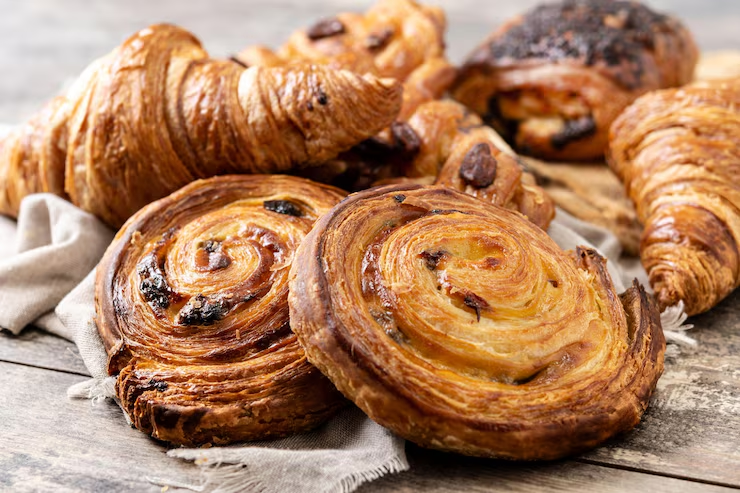
Sourdough vs Croissant Margins: The Core Economics of Bakery Menu Design Dubai Trends
Before you can design a great bakery menu, you need to understand the economics of your most important products. In the Dubai artisan bakery context, no two products better illustrate the margin dynamics at play than sourdough and the croissant. Understanding sourdough vs croissant margins is fundamental to any serious bakery menu design Dubai trends strategy.
Sourdough: The Long-Game Margin Product
Sourdough is the foundational product of the artisan bakery movement. Its ingredients are extraordinarily simple: flour, water, salt, and a live starter culture. This simplicity, however, belies a complex production process that takes anywhere from 24 to 72 hours, requires precise temperature control, skilled shaping, and steam-injected deck ovens.
| Cost Component | AED Per Loaf (750g) | Notes |
| Flour (heritage/specialty) | 3.50–5.50 | French T65, Emirati wheat, spelt blends |
| Water & salt | 0.20–0.40 | Filtered water, quality sea salt |
| Energy (oven) | 0.80–1.50 | Deck oven, 30–45 min at 250°C |
| Baker labour (allocated) | 3.00–6.00 | Based on production volume |
| Packaging & labelling | 1.00–2.00 | Branded bag or paper |
| Total Cost | 8.50–15.40 | Variable by scale |
| Retail Price (Dubai) | 28–48 | Based on location and brand |
| Gross Margin | 45–70% | Higher at scale with efficient production |
Sourdough’s margin improves significantly with scale. A bakery producing 50 loaves per day achieves very different economics than one producing 200. This is where daily production volume calculation becomes a critical management discipline, which we will cover in detail below.
Croissant: The High-Drama, High-Reward Product
The croissant is the ultimate test of a baker’s skill and the ultimate premium product on your bakery menu design Dubai trends menu. Laminated dough — the technique behind a croissant — requires precise temperature management, multiple folds (‘turns’), European-grade butter, and skilled hands. It is labour-intensive and technically demanding. But the rewards, when done right, are exceptional.
| Cost Component | AED Per Croissant (80–90g) | Notes |
| European butter (block, 84% fat) | 2.80–4.50 | Key determinant of quality and cost |
| Flour, eggs, milk, yeast, salt | 0.80–1.40 | Premium flour makes a difference |
| Energy (proofing + baking) | 0.40–0.80 | Convection oven for even bake |
| Baker labour (allocated) | 2.50–4.50 | High-skill, time-intensive process |
| Packaging (bag/box) | 0.50–1.20 | Presentation is critical |
| Total Cost | 7.00–12.40 | |
| Retail Price (Dubai) | 18–38 | Plain to filled/specialty |
| Gross Margin | 50–65% | Filled/specialty croissants higher margin |
The sourdough vs croissant margins comparison reveals an important insight: croissants have a narrower base margin than sourdough, but filled and specialty croissants (pistachio cream, saffron custard, Emirati-inspired products like dates and cardamom) command 30–50% price premiums with only marginally higher ingredient costs. This is where smart bakery menu design Dubai trends can transform margin performance.
👉 Shop Convection Ovens for Consistent Croissant Baking
👉 Explore Combi Ovens for Bakery Versatility
Emirati-Inspired Products: The Highest Opportunity in Bakery Menu Design Dubai Trends
If there is one area where Dubai bakeries have a unique, defensible competitive advantage that bakeries in Paris, New York, or London simply cannot replicate, it is in the authentic, creative integration of Emirati-inspired products into their menus. This is not just a trend — it is a cultural responsibility and a profound commercial opportunity.
The integration of Emirati flavours, ingredients, and traditions into the modern bakery format represents the most exciting frontier in bakery menu design Dubai trends. Done authentically and with respect, these products create genuine differentiation, generate intense social media engagement, and allow you to charge premium prices that standard Western offerings cannot justify.
The Most High-Potential Emirati-Inspired Bakery Products
• Luqaimat Reimagined: The traditional Emirati fried dough ball, elevated with specialty fillings — date paste and tahini, saffron custard, dark chocolate ganache. Retail AED 12–22 per serving.
• Karak Chai Croissant: Laminated dough infused with condensed milk and cardamom, filled with spiced karak reduction. A genuinely unique product that generates automatic social sharing. AED 22–32.
• Saffron & Dates Sourdough: Whole loaf incorporating UAE saffron and Medjool dates from Al Ain. Extraordinary aroma, deeply local identity. AED 48–72.
• Balaleet-Inspired Sweet Vermicelli Tart: Sweet vermicelli, cardamom, rose water, and egg custard in a butter pastry shell. AED 16–28.
• Rigag Flatbread: The traditional Emirati paper-thin flatbread, modernised as an artisan sourdough variant with premium toppings. AED 22–38.
• Date & Cardamom Financiers: French financier base with Emirati Sukkari dates and freshly ground cardamom. AED 10–16 each.
The key principle behind successful Emirati-inspired products is authenticity over appropriation. Work with Emirati food historians, source local ingredients from UAE farmers and producers, and tell those stories on your menu. This approach transforms your bakery menu design Dubai trends from a Dubai-located bakery into a Dubai-rooted bakery — a distinction that commands significantly higher prices and deeper customer loyalty.
👉 Browse Food Holding & Warming Equipment for Bakery Display
Vegan & Gluten-Free Demand: Non-Negotiable in Bakery Menu Design Dubai Trends
Five years ago, a Dubai bakery could get away with offering one or two vegan options and a token gluten-free brownie. In 2024–2026, that approach is commercially negligent. The vegan & gluten-free demand in Dubai has reached a level where it fundamentally shapes your bakery menu design Dubai trends and your production infrastructure.
The Scope of Vegan & Gluten-Free Demand in Dubai
According to industry data from the UAE food service sector, approximately 15–20% of active café and bakery customers in Dubai identify as vegan, plant-based, or dairy-free. An estimated 8–12% report gluten sensitivity or celiac conditions. Critically, these customers are among the highest-spending segments — they actively seek out establishments that cater to them and reward those businesses with intense loyalty and word-of-mouth referrals.
read more : Most Profitable Restaurant Concept Dubai 2026: Top Ideas to Open Right Now
Building a Commercially Viable Vegan Bakery Section
Addressing vegan & gluten-free demand effectively means more than swapping dairy butter for vegan alternatives. It requires:
• Dedicated Equipment: Separate mixing bowls, proofing baskets, and baking trays to prevent cross-contamination. Critical for gluten-free credibility.
• Ingredient Investment: Quality vegan butter (e.g., Miyoko’s, Violife), oat-based cream, aquafaba, and certified gluten-free flour blends. These cost more but allow higher retail pricing.
• Technical Skill Development: Vegan croissants (using plant-based butter) and gluten-free sourdough (using rice flour, tapioca, and psyllium husk) are technically more challenging than their standard equivalents. Training investment is non-negotiable.
• Clear Labelling: Every vegan and gluten-free item must be clearly, unambiguously labelled on your menu board and product tags. This is both a legal requirement under UAE food safety regulations and a commercial signal to the growing segment actively seeking these products.
Vegan & Gluten-Free Margin Performance
| Product | Cost (AED) | Retail (AED) | Notes |
| Vegan Croissant | 9–14 | 24–42 | Premium positioning vs standard |
| Gluten-Free Sourdough (400g) | 14–20 | 45–68 | GF flour blends are costly |
| Vegan Almond Tart | 7–11 | 28–45 | Strong margin, high demand |
| GF Brownie | 4–7 | 18–28 | Gateway product for GF segment |
| Vegan Date & Walnut Loaf | 8–12 | 32–48 | Emirati ingredients crossover |
The premium pricing that vegan & gluten-free demand supports is one of the most compelling margin opportunities in bakery menu design Dubai trends. A vegan croissant retailing at AED 38 versus a standard croissant at AED 22 represents a 73% price premium on a product with only marginally higher ingredient costs.
👉 Explore Stainless Steel Equipment for Dedicated Production Areas
Daily Production Volume Calculation: The Engine of Sustainable Bakery Menu Design Dubai Trends
One of the most common causes of bakery failure — even among talented bakers with excellent products — is the absence of a rigorous daily production volume calculation framework. Without understanding exactly how much you can produce, what it costs to produce it, and how much you need to sell to break even, your bakery menu design Dubai trends strategy has no financial foundation.
The Daily Production Volume Framework
Building a daily production volume calculation system requires you to understand and track these five variables:
1. Production Capacity
What can your oven(s) physically produce in a working day? A standard bakery deck oven with two to three decks can handle approximately 40–80 standard loaves or 120–200 croissants per day. Knowing this ceiling is non-negotiable.
2. Prep-to-Production Ratio
Croissants require 24–48 hours of prep (mixing, laminating, proofing). Sourdough requires 24–72 hours. Your daily production volume calculation must account for this lead time, meaning today’s sales plan actually starts with yesterday’s (or the day before’s) production decisions.
3. Yield Loss Rate
Not every unit that enters the oven comes out perfect. Factor in a 5–10% yield loss for artisan products. Your production volume must cover both your sellable target and your wastage.
4. Revenue Target per Production Run
If your daily overhead (rent, labour, utilities, ingredient cost) totals AED 4,500 and your average transaction value is AED 65, you need to serve approximately 70 customers daily to break even. Your daily production volume calculation must be calibrated to produce enough sellable units to achieve that customer count.
5. Sell-Through Rate Management
Unsold bakery products at end of day represent pure loss. Track your sell-through rate weekly by product. A target of 90–95% sell-through is ideal. Products consistently below 75% should be produced in smaller volumes or redesigned.
A Practical Daily Production Volume Calculator
| Metric | Formula | Example (Mid-Sized Dubai Bakery) |
| Daily revenue target | Monthly overhead ÷ 30 | AED 5,200/day |
| Average transaction value | From POS data | AED 68 |
| Customers needed | Revenue target ÷ ATV | ~76 customers |
| Units needed (2 items/customer avg) | Customers × avg items | ~152 units |
| Production target (+ 8% yield loss) | Units needed × 1.08 | ~164 units total |
| Oven capacity check | Units ÷ batches per oven | Must fit in available oven capacity |
This daily production volume calculation approach transforms your bakery menu design Dubai trends from a creative exercise into a financially grounded business discipline. Every product on your menu should have a defined production volume, cost, and revenue contribution.
👉 Shop Cook and Hold Ovens to Maximise Production Efficiency
👉 Explore Stainless Steel Fabrication for Bakery Worktables
Pricing vs Competitor Cafés: How to Position Your Bakery Menu Design Dubai Trends
Setting prices for your bakery menu in Dubai without a clear understanding of the competitive landscape is one of the most expensive mistakes a bakery owner can make. Your pricing vs competitor cafés strategy is the bridge between your cost structure and what the market will bear — and in Dubai, that bridge has many lanes.
Mapping the Dubai Bakery Competitive Landscape
Dubai’s bakery and café market spans a wide price spectrum. Understanding where each segment operates helps you position your bakery menu design Dubai trends strategically:
• Ultra-Premium Artisan (AED 35–80+ per item): French-trained pastry chefs, imported specialty ingredients, architectural pastry presentations. Examples: Comptoir 102, some Four Seasons hotel bakeries. You compete here on quality and story, not convenience.
• Premium Independent Bakeries (AED 18–45): The sweet spot for most serious artisan operations in Dubai. Strong quality, clear identity, authentic sourcing. This is where bakery menu design Dubai trends differentiation matters most.
• Mid-Range Café-Bakery Hybrids (AED 12–25): Quality is secondary to convenience and volume. These are dangerous pricing comparators — never benchmark against them for artisan products.
• Quick-Service and Chain Bakeries (AED 5–18): Dekalb, Paul, Eric Kayser (franchised). Strong brand awareness but commodity-level differentiation. Not your competition.
Pricing vs Competitor Cafés: A Practical Benchmarking Table
| Product | Chain/QSR Price (AED) | Premium Independent (AED) | Ultra-Premium (AED) | Your Recommended Price (AED) |
| Plain Croissant | 8–14 | 18–28 | 30–42 | 22–32 |
| Filled Croissant | 12–18 | 24–38 | 40–65 | 30–48 |
| Sourdough Loaf (750g) | 18–28 | 32–52 | 55–80 | 38–58 |
| Vegan Tart | 14–20 | 28–45 | 48–70 | 32–50 |
| Emirati-Inspired Pastry | N/A | 22–38 | 42–68 | 28–48 |
| GF Brownie | 10–16 | 18–28 | 28–42 | 22–32 |
| Specialty Bread Loaf | 20–32 | 38–62 | 60–90 | 45–68 |
Your pricing vs competitor cafés positioning should aim for the upper range of the premium independent tier. This is achievable if your bakery menu design Dubai trends communicates quality through: visibly artisan production, compelling ingredient narratives, polished menu design, and consistent product quality.
👉 Browse All Commercial Ovens for Bakery Operations in Dubai
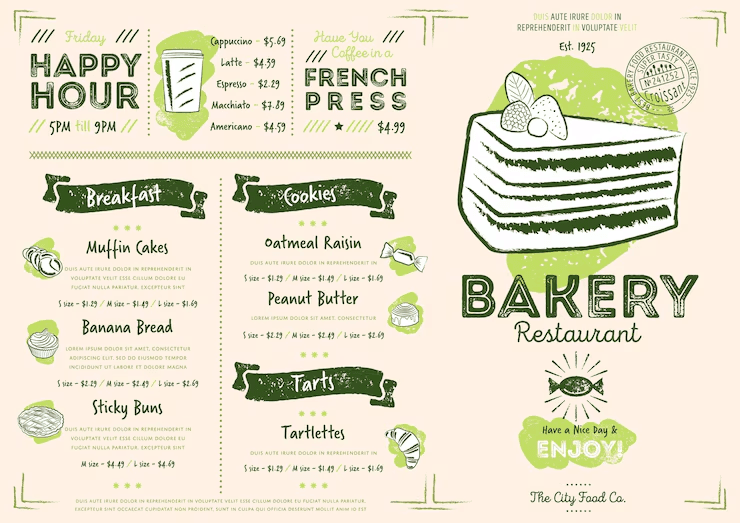
Menu Design and Layout: The Visual Foundation of Bakery Menu Design Dubai Trends
Your physical or digital menu is the silent salesperson in your bakery. The most beautifully made croissant in Dubai can be underpriced and undersold by a poorly designed menu. Bakery menu design Dubai trends encompass not just what you sell and what you charge, but how the visual presentation of your menu communicates value and guides purchasing decisions.
Core Principles of High-Converting Bakery Menu Design
• Hierarchy by Margin: Place your highest-margin items at the top right or centre of your menu — the zones where eyes naturally travel first. These are typically your specialty croissants, Emirati-inspired products, and filled pastries.
• Storytelling Over Listing: ‘Croissant — AED 22’ is a listing. ‘Normandy Butter Croissant — 72-hour lamination, Charentes-Poitou AOP butter, caramelised exterior, silk-smooth interior — AED 28’ is storytelling. The second justifies a 30% premium.
• Dietary Icons Done Right: Vegan, gluten-free, nut-free, dairy-free icons should be clean, professional, and consistent — not afterthoughts. They serve the vegan & gluten-free demand segment and signal that you take dietary needs seriously.
• Seasonal Indicators: ‘Available until end of November’ or a small calendar icon drives urgency and scarcity perception.
• Photography in Menus: Only include photography if it is professional and genuinely appetising. Mediocre food photography does more harm than no photography. In-store display cases speak louder than bad images.
Production Equipment and Its Role in Bakery Menu Design Dubai Trends
Your production equipment is the physical infrastructure of your bakery menu design Dubai trends strategy. Every product on your menu that you cannot produce consistently and at scale is a liability. Equipment investment is not a cost — it is the mechanism through which your menu becomes real.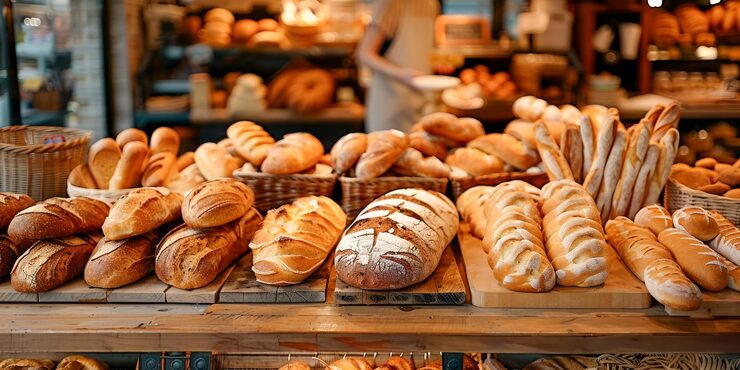
Essential Equipment for a Dubai Artisan Bakery
• Deck Ovens: Non-negotiable for authentic sourdough. Steam injection capability is essential for crust development. A two-deck oven is the minimum viable production setup for a commercial bakery.
• Convection Ovens: Essential for croissants, tarts, cookies, and any product requiring even, circulated heat. Many Dubai bakeries run deck and convection ovens in parallel.
• Dough Sheeters & Laminators: For any bakery serious about laminated dough at scale, a floor-standing dough sheeter is essential for consistency and speed.
• Spiral Mixers: For sourdough at volume, a spiral mixer with a minimum 20-litre capacity is the standard.
• Proofing Chambers: Precise temperature and humidity control for proofing is critical — especially for vegan & gluten-free demand products that behave differently from standard dough.
• Display Refrigeration: Your pastry display case is your storefront. Premium refrigerated display cases with appropriate humidity control ensure your products look as beautiful at 5pm as they did at 8am.
👉 Shop Undercounter Freezers for Bakery Dough Storage
👉 Explore Work Top Chillers for Pastry Production Stations
👉 Browse Food Preparation Equipment for Bakery Operations
👉 Shop Stainless Steel Equipment for Bakery Workspaces
Frequently Asked Questions
What are the top bakery menu design trends in Dubai for 2024–2026?
The dominant bakery menu design Dubai trends include artisan sourdough, laminated pastry with specialty fillings, Emirati-inspired products like date-filled luqaimat and saffron croissants, expanded vegan & gluten-free demand sections, and menu storytelling with ingredient origin narratives.
What is the profit margin on croissants in a Dubai bakery?
Based on current Dubai ingredient and labour costs, standard croissants typically achieve 50–65% gross margin. Specialty filled and Emirati-inspired products croissants can achieve 60–70%+ due to premium pricing. This comparison is central to understanding sourdough vs croissant margins in a Dubai context.
How do I calculate daily production volume for a bakery?
A daily production volume calculation starts with your daily revenue target (monthly overhead ÷ 30), divided by your average transaction value to determine the number of customers needed. Multiply by average items per customer, then add 8–10% for yield loss to get your total production target.
How should a Dubai bakery price against competitor cafés?
Your pricing vs competitor cafés strategy should position you in the premium independent tier — above chain bakeries and quick-service operators, at parity with or slightly above comparable artisan independents. Never benchmark against mainstream chains for artisan products.
What Emirati ingredients work best in a modern Dubai bakery?
The highest-performing Emirati-inspired products use Medjool and Sukkari dates from the UAE, domestic saffron, cardamom, rose water, camel milk, and local honey. Rigag flatbread dough, balaleet-inspired sweet vermicelli, and karak chai infusions offer compelling fusion opportunities.
Is there genuine demand for vegan and gluten-free bakery products in Dubai?
Yes, significantly. The vegan & gluten-free demand in Dubai represents 15–20% of active café and bakery customers, concentrated in affluent areas and among health-conscious expat and Emirati consumers. These customers are high-spending and highly loyal to bakeries that serve them well.
What oven is best for artisan sourdough in a Dubai bakery?
A bakery deck oven with steam injection capability is the industry standard for authentic sourdough. Two to three decks allow concurrent production of different products. For croissants and vegan pastries, a professional convection oven running parallel provides the flexibility needed for a full bakery menu design Dubai trends offering.
How important is menu design for bakery pricing in Dubai?
Critically important. Customers in Dubai are highly visually literate and spend 30–60 seconds evaluating a menu before ordering. A professionally designed menu with product storytelling, dietary icons, and clear visual hierarchy can justify 20–40% higher prices for the same product compared to a plainly described menu.
How do I reduce waste in a Dubai bakery?
Integrate daily production volume calculation into your operations — track sell-through rates weekly by product, adjust production quantities based on data rather than intuition, and design a clear end-of-day discount or repurposing system (day-old sourdough bread pudding, croissant croutons). Target 90–95% sell-through across all products.
What is the best margin product for a small Dubai bakery?
For small operations, specialty filled pastries and Emirati-inspired products typically offer the best margin performance — combining moderate ingredient costs with significant price premiums driven by uniqueness and story. Sourdough loaves offer strong margins at scale. Vegan tarts and gluten-free specialty items command the highest premium relative to cost in the current bakery menu design Dubai trends market.
Conclusion: Building Your Bakery’s Future on Strong Menu Foundations
Dubai’s bakery market in 2024–2026 is a market of extraordinary opportunity — for those who approach it with both craft excellence and business intelligence. Bakery menu design Dubai trends are not abstract aesthetic decisions. They are strategic, financial, operational, and cultural choices that determine whether your bakery thrives or merely survives.
Master your sourdough vs croissant margins, build authentic Emirati-inspired products that no competitor can copy, invest seriously in vegan & gluten-free demand to capture the highest-spending dietary segment, build your daily production volume calculation into a management habit, and position your pricing vs competitor cafés strategy with confidence in the premium independent tier.
Every great bakery in Dubai started with a great menu. Your menu is your promise, your story, and your business plan — all in one. Build it well, invest in the equipment that makes it real, and let the quality speak for itself.
If this guide gave you value, share it with your network, leave your experience in the comments, and explore the related content on our website. Your bakery menu design Dubai trends journey starts with the right foundations — and the right equipment to back it up.
👉 Explore All Commercial Ovens for Bakery Operations in Dubai
👉 Browse Restaurant Kitchen Equipment for Complete Bakery Setup
👉 Shop All Stainless Steel Fabrication for Bakery Workspaces