Food Cost Percentage UAE Restaurant: How to Calculate & Hit Your Target
6 June 2026
Imagine this: your restaurant in Dubai is packed every evening. The tables are full, the orders keep coming, and the kitchen never stops. Yet, at the end of the month, you stare at the numbers and wonder where all the profit went. Sound familiar? You are not alone. Across the UAE — from Abu Dhabi cloud kitchens to Sharjah family diners — one silent killer devours restaurant margins more than any other: an uncontrolled food cost percentage UAE restaurant owners rarely measure with the precision it demands.
Food cost percentage is not just an accounting term. It is the heartbeat of your restaurant’s financial health. Get it right, and you unlock the ability to price your menu confidently, negotiate with suppliers from a position of strength, reduce waste systematically, and grow with stability. Get it wrong, and no amount of Instagram marketing or footfall will save your bottom line. This guide will walk you through everything — the formulas, the benchmarks, the tools, and the mindset — so you can take full control of your food cost percentage UAE restaurant operations starting today.
What Is Food Cost Percentage UAE Restaurant and Why Does It Matter?
Before you can control something, you need to understand exactly what it is. Food cost percentage UAE restaurant refers to the ratio of the money you spend on food ingredients to the revenue those ingredients generate through sales. Expressed as a percentage, it tells you how much of every dirham earned goes directly back into buying the raw materials on your plate.
The Simple Definition
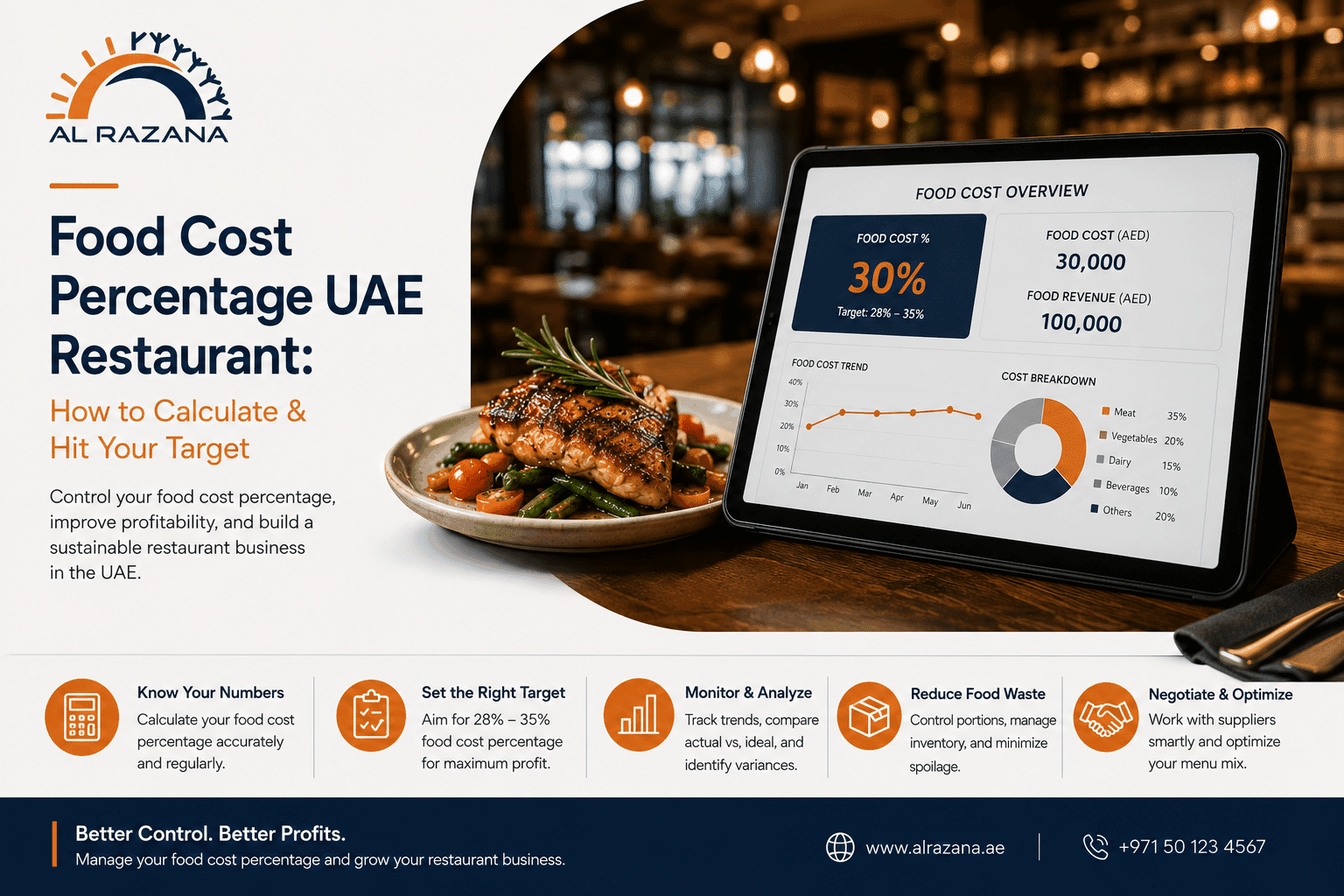
Food cost percentage is calculated by dividing your total food cost by your total food revenue, then multiplying by 100. If you spend AED 30,000 on ingredients in a month and generate AED 100,000 in food sales, your food cost percentage is 30%. In the UAE restaurant industry, most full-service restaurants aim for a food cost percentage between 28% and 35%, while quick-service and fast-food outlets may target lower — sometimes as tight as 22% to 28%.
Why This Metric Is Critical in the UAE Market
The UAE presents a unique set of economic pressures on restaurant operators. Import dependency is extremely high — estimates suggest that over 80% of the UAE’s food supply is imported. This means ingredient prices are constantly subject to global commodity fluctuations, shipping costs, currency exchange rates, and regional supply chain disruptions. A conflict in Eastern Europe pushes up wheat prices. A shipping delay at Jebel Ali port means your premium proteins arrive late or not at all. Each of these factors directly impacts your food cost percentage UAE restaurant in ways that a business owner who doesn’t track this number simply won’t catch until it’s too late.
Beyond imports, the UAE’s diverse culinary landscape — catering to Emirati, South Asian, Levantine, East Asian, and Western palates simultaneously — means menus are complex, ingredient lists are long, and waste opportunities are plentiful. Managing this complexity without a clear handle on food cost percentage is like driving a truck in fog without headlights.
The Relationship Between Food Cost and Restaurant Profitability
Restaurant economics follow a simple but demanding structure. Your revenue must cover food costs, labor costs, rent, utilities, marketing, and still leave a healthy net profit. Industry benchmarks suggest that food costs should not exceed 30–35% of revenue, labor costs should stay under 30–35%, and occupancy costs ideally below 10%. If your food cost percentage UAE restaurant creeps to 40% or 45%, there is almost no mathematical pathway to profitability — regardless of how busy you are.
How to Calculate Food Cost Percentage UAE Restaurant: The Complete Formula
Most restaurant owners know food cost percentage exists. Far fewer calculate it correctly, consistently, or in a way that drives real decisions. Here is the full methodology, from the basic formula to the more nuanced actual-cost calculation.
The Basic Formula
The foundational formula for food cost percentage is:
Food Cost Percentage = (Total Food Cost ÷ Total Food Revenue) × 100
For a single dish, the formula becomes:
Dish Food Cost % = (Ingredient Cost of Dish ÷ Menu Price of Dish) × 100
For example, if a lamb kofta dish costs AED 18 in ingredients and you sell it for AED 65, the food cost percentage for that item is 27.7%. This is a healthy number. If another dish — say a seafood platter — costs AED 90 in ingredients and sells for AED 180, its food cost percentage is 50%, which is deeply problematic unless compensated by very low-cost items elsewhere on the menu.
The Actual Food Cost Calculation (Monthly Period)
The more accurate and actionable formula accounts for your opening and closing inventory:
Actual Food Cost = (Opening Inventory + Purchases) – Closing Inventory
Then divide by total food sales to get the percentage:
Actual Food Cost % = (Actual Food Cost ÷ Total Food Sales) × 100
This formula is critical because it captures waste, theft, spoilage, and over-portioning — all the “invisible” losses that inflate your food cost percentage UAE restaurant beyond what your recipe cards would predict. If your recipe-based theoretical food cost says you should be at 29%, but your actual food cost comes to 38%, that 9% gap is telling you something is seriously wrong in your kitchen operations. This difference is what professionals call the ideal vs actual cost gap, and investigating it is one of the highest-value activities any UAE restaurant manager can undertake.
Understanding the Ideal vs Actual Cost Gap
The ideal vs actual cost gap is the difference between what your food cost should be (based on standardized recipes and correct portioning) and what it actually is (based on real inventory movements). A gap of 1–2% is normal and acceptable. A gap of 5% or more is a red flag that demands immediate investigation. Common causes include:
- Over-portioning by kitchen staff — especially in high-pressure service periods
- Food waste during preparation — trimming losses, cooking spoilage, plating errors
- Theft — both internal (staff) and external (incorrect deliveries going unchallenged)
- Supplier short-weights — receiving less than what you paid for
- Recipe non-compliance — chefs improvising instead of following standardized recipes
- Unrecorded staff meals or complimentary dishes not being tracked in the POS system
Recipe Costing Template: The Foundation of Food Cost Percentage UAE Restaurant Control
You cannot manage what you have not measured, and you cannot measure food cost accurately without a detailed recipe costing template for every item on your menu. A recipe costing template is a structured document — digital or physical — that lists every ingredient in a dish, the exact quantity used per portion, the unit cost of each ingredient, and the resulting total ingredient cost for that dish. When built correctly, it becomes the single source of truth for your entire menu’s financial performance.
How to Build a Recipe Costing Template for UAE Restaurants
Building a recipe costing template for your UAE restaurant requires a systematic approach. Here is a step-by-step process:
- List every ingredient in the dish by name. Be specific — don’t write “oil,” write “extra virgin olive oil.” Don’t write “chicken,” write “fresh boneless chicken breast, skin-off.”
- Record the exact quantity per portion. Use grams for solids and milliliters for liquids. Avoid vague terms like “a handful” or “a pinch.” Kitchen scales are non-negotiable for this step.
- Enter the latest purchase price per unit. Use the price per kilogram or per liter from your most recent supplier invoice. This must be updated whenever supplier prices change.
- Calculate the cost per ingredient line. Multiply quantity used by price per unit. A simple spreadsheet handles this automatically.
- Add a waste/trim factor. Account for the fact that a 1kg piece of raw lamb may yield only 700g of usable meat after trimming. Your effective cost per usable gram is therefore higher than the raw purchase price.
- Sum all ingredient costs to get the total dish cost. This is your theoretical food cost per portion.
- Add a small packaging cost for delivery or takeaway items — this is increasingly relevant in the UAE’s booming delivery market.
- Divide the total dish cost by your intended selling price to calculate the food cost percentage for that item.
A well-maintained recipe costing template updated monthly becomes your most powerful tool for managing food cost percentage UAE restaurant across your entire menu. It also makes the conversations with your chef and kitchen team data-driven rather than intuition-based.
Digital Recipe Costing Tools Used in UAE Restaurants
Several software platforms are actively used by UAE restaurant operators for recipe costing. These include MarketMan, Apicbase, Netsuite Food & Beverage, and locally popular POS-integrated systems like POSRocket and Foodics. Foodics in particular has significant market penetration in the Gulf region and offers built-in recipe costing, waste tracking, and inventory management features tailored to Arabic-language menus and multi-branch operations. However, even a well-structured Excel or Google Sheets recipe costing template is far better than having no system at all — and it’s where most new UAE restaurant operators should start before investing in enterprise software.
Explore Professional Restaurant Kitchen Equipment
Supplier Price Negotiation: How to Reduce Your Food Cost Percentage UAE Restaurant From the Source
One of the most powerful yet underutilized levers for controlling food cost percentage UAE restaurant is the purchasing side of the equation. Many UAE restaurant owners accept supplier quotes passively, treating them as fixed input costs rather than negotiable variables. This is a costly mistake. Aggressive, strategic supplier price negotiation can shave 3–8% off your ingredient costs without changing a single recipe or menu price.
The Psychology and Strategy of Supplier Price Negotiation
UAE food suppliers — whether you’re buying from Emirates National Food (ENFS), Al Maya, Bidfood Middle East, or specialist butchers and fishmongers in Dubai’s wholesale markets — operate on volume economics. The more you buy, the more margin they have to offer. The key to successful supplier price negotiation is preparing like a business professional, not approaching it as a casual conversation.
Before entering any supplier negotiation, arm yourself with three pieces of information: your current price per unit from that supplier, the best alternative price you’ve found from a competing supplier, and your projected volume of purchases over the next three to six months. Suppliers respond to certainty of volume. If you can commit to 200kg of boneless chicken per week versus ordering unpredictably, you will get a better price. Put it in writing through a short-term supply contract.
Practical Supplier Negotiation Tactics for UAE Restaurants
- Get at least three quotes for every major ingredient category. Protein, dairy, and produce are the three highest-cost categories for most UAE menus. Never rely on a single supplier for any of them without checking alternatives quarterly.
- Consolidate your supplier base strategically. Buying more from fewer suppliers increases your leverage. If you currently spread your purchasing across eight suppliers, consolidating to four while increasing per-supplier volume will unlock better pricing.
- Negotiate payment terms alongside price. Extending from 7-day to 30-day payment terms improves your cash flow — which is often as valuable as a price reduction.
- Create a price escalation clause in contracts. For volatile commodities like cooking oil, chicken, and imported cheese, agree in advance on how price increases will be handled — ideally with a cap tied to a commodity index.
- Visit the wholesale markets in person. The Wholesale Market in Deira (Dubai), the Central Market in Abu Dhabi, and the International City wholesale area are all worth visiting to benchmark your current supplier prices against spot market rates.
- Leverage the relationship, not just the price. Long-standing supplier relationships in the UAE often deliver benefits beyond price — priority delivery, better quality cuts, flexibility on short orders during busy periods. Don’t damage these for the sake of a few fils per kilogram.
The Link Between Supplier Negotiation and Menu Engineering
When you successfully reduce ingredient costs through supplier price negotiation, the benefits flow directly into your food cost percentage UAE restaurant reduction. A 5% reduction in your protein costs — often 40–50% of a UAE restaurant’s food spend — can move your overall food cost percentage by 1.5–2 full percentage points. That translates into thousands of dirhams in additional monthly profit without a single extra customer walking through the door.
Browse Commercial Cooking Equipment for UAE Restaurants
Waste Tracking System: The Hidden Driver of Food Cost Percentage UAE Restaurant
Waste is the enemy of profitability in any UAE restaurant kitchen, and it comes in many more forms than the obvious bin full of trimmings at the end of service. An effective waste tracking system doesn’t just count what goes in the bin — it tracks every dirham of food value that fails to reach a paying customer as intended. Setting up a rigorous waste tracking system is one of the most actionable steps any UAE restaurant can take to immediately reduce its food cost percentage UAE restaurant.
Types of Food Waste in UAE Restaurants
Understanding the different categories of waste is the first step to controlling them:
- Preparation waste: Trimmings, peelings, and unusable parts of raw ingredients. This is the most visible category and is often tracked reasonably well in professional kitchens — but the trim factor is rarely built into recipe costing accurately.
- Over-production waste: Food prepared but not sold — especially common in buffet setups, which are extremely popular in UAE hotel restaurants and iftar spreads during Ramadan.
- Plate waste: Food that customers leave on the plate. While this doesn’t technically come out of your food cost (you already sold it), high plate waste is a signal of portion sizing or quality issues that will eventually damage your reputation and revenue.
- Spoilage waste: Ingredients that expire before use due to poor stock rotation, over-ordering, or inadequate refrigeration. This is a direct food cost hit and is preventable.
- Cooking waste: Food burned, dropped, plated incorrectly, or returned from the pass due to errors. Every rejected plate represents a full ingredient cost write-off.
- Staff meal and complimentary waste: The cost of staff meals and guest complimentaries must be tracked separately — not because they’re wrong, but because they need to come out of the correct budget line and not inflate your apparent food cost percentage.
Building a Waste Tracking System in Your Kitchen
A practical waste tracking system for a UAE restaurant doesn’t require expensive software to start. Here is a simple, effective implementation:
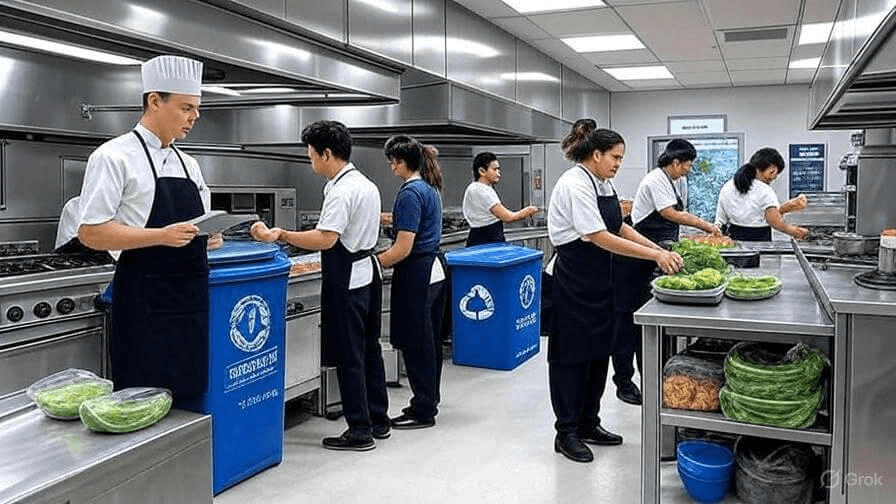
- Place a waste log at every kitchen station. This is a simple sheet where station chefs record every item discarded, the quantity, and the reason (prep trim, overcook, drop, return, spoilage). Make it non-punitive — the goal is data, not blame.
- Weigh significant waste categories daily. For proteins especially, daily weighing of preparation waste against purchased weight gives you a real trim yield percentage that should feed back into your recipe costing templates.
- Review waste logs weekly with the kitchen team. Turn the data into a 15-minute team discussion — which stations have the highest waste? What can be done differently?
- Set waste targets by category. For example: protein prep waste below 15% of purchased weight; daily over-production below AED 200 value; zero spoilage waste per week.
- Integrate waste data into your monthly food cost calculation. The waste tracking system data should explain a large part of your ideal vs actual cost gap. If actual cost is 6% above ideal, your waste logs should account for most of that difference.
Technology Tools for Waste Tracking in the UAE
For larger or multi-branch operations, dedicated waste management technology platforms like Winnow (which has an active presence in the UAE and Gulf region, working with several large hotel groups and food courts) use AI-powered image recognition and scales to automatically categorize and value waste in real time. Leanpath is another global platform gaining traction in the UAE hospitality sector. These platforms can reduce food waste by 40–70% in large kitchen environments — directly translating into a substantial reduction of your overall food cost percentage UAE restaurant.
Discover Commercial Refrigeration Solutions to Reduce Spoilage
Menu Price Adjustment Triggers: When to Reprice for Food Cost Percentage UAE Restaurant
Knowing your food cost percentage is only half the battle. The other half is having a clear framework for when and how to adjust your menu prices in response to changing ingredient costs. Many UAE restaurant owners are reluctant to raise prices — fearing customer backlash — and as a result absorb supplier cost increases that quietly push their food cost percentage UAE restaurant into unprofitable territory. Understanding menu price adjustment triggers gives you a proactive, data-driven system rather than a reactive, fear-driven one.
The Key Menu Price Adjustment Triggers
The following conditions should serve as clear signals that menu price review is necessary:
- Food cost percentage rises above your target by 3+ percentage points. If your target is 30% and your actual food cost percentage has climbed to 33% or above for two consecutive months, a menu price review is overdue.
- A key ingredient’s price increases by 15% or more. Tracking the cost of your top 10 most-used ingredients monthly allows you to identify when a single commodity shift — like a spike in chicken prices, cooking oil, or imported dairy — is pushing individual dish food costs above their target percentage.
- A new supplier contract is signed at higher prices. The moment you lock in a new supply agreement at higher rates, your recipe costs need to be recalculated and menu price adjustment triggers should be evaluated immediately.
- Your menu hasn’t been reviewed in more than 6 months. In the UAE’s import-dependent food environment, ingredient prices rarely stand still for more than a quarter. A biannual menu price review should be standard practice — not an emergency response.
- A dish’s food cost percentage consistently exceeds 40%. Any item on your menu where ingredient costs consistently consume 40% or more of the sale price is either priced too low, over-portioned, or using unnecessarily expensive ingredients. It is a candidate for repricing, re-engineering, or removal.
How to Adjust Menu Prices Without Losing Customers
Price increases need not be sudden or dramatic. Several strategies allow UAE restaurants to adjust menu prices in response to food cost pressure while maintaining customer satisfaction:
- Portion re-engineering: Reducing portion sizes by 5–10% while maintaining presentation quality effectively increases your yield per kilogram of ingredient purchased, reducing food cost percentage without changing the menu price.
- Menu mix optimization: Promote high-margin items more aggressively through menu design, server recommendations, and digital marketing. Even without changing a single price, shifting your sales mix toward higher-margin dishes improves your blended food cost percentage.
- Graduated price increases: Rather than a single large price increase that shocks customers, implement small increases (5–8%) across the menu at regular intervals, framed as quality upgrades or new menu launches.
- Communicate value before price: If you are raising prices, make the upgrade visible — improved ingredient sourcing, better presentation, a new dish description that highlights premium elements. Customers accept price increases more readily when they see concurrent value improvements.
Shop Food Preparation Equipment to Improve Yield and Reduce Waste
Setting Your Target Food Cost Percentage UAE Restaurant by Concept Type
Not all UAE restaurant formats operate to the same food cost benchmarks. Understanding the right target for your specific concept is essential before you start measuring performance against the wrong yardstick. Here is a breakdown of typical food cost percentage UAE restaurant benchmarks by concept:
Benchmark Table: Food Cost Percentage by UAE Restaurant Type
| Restaurant Concept | Target Food Cost % | Notes |
| Fine Dining (DIFC, Downtown Dubai) | 28% – 35% | Premium ingredients; higher revenue per cover compensates |
| Casual Dining (Mall Restaurants) | 28% – 33% | High volume; tight portion control critical |
| Quick Service / Fast Food | 22% – 28% | Standardized recipes; high turnover; low labor per dish |
| Café / Bakery | 25% – 32% | Beverage margin boosts overall profitability |
| Buffet Restaurants | 30% – 38% | Over-production waste is the key risk to manage |
| Cloud Kitchen / Delivery Only | 25% – 32% | No dine-in revenue; food cost must compensate for delivery platform fees |
| Hotel Restaurant (F&B Department) | 30% – 40% | Often subsidized by room rates; higher food cost acceptable |
| Emirati / Arabic Concept | 28% – 36% | Protein-heavy menus; lamb and seafood cost management critical |
These benchmarks are starting points, not rigid rules. Your specific food cost target must account for your labor cost structure, rent as a percentage of sales, and the overall profit margin you are working toward. If your rent is 15% of revenue (high for Dubai), you may need to target a food cost percentage of 26–28% rather than 30–33% to reach profitability.
The Role of Kitchen Equipment in Controlling Food Cost Percentage UAE Restaurant
Many restaurant owners think of food cost control purely in terms of menu pricing and purchasing. What they underestimate is how profoundly the quality, efficiency, and reliability of their kitchen equipment affects food cost percentage UAE restaurant outcomes. The right equipment reduces waste, improves yield, ensures portion consistency, and reduces the energy costs embedded in food preparation — all of which directly or indirectly affect your food cost percentage.
Refrigeration and Spoilage Prevention
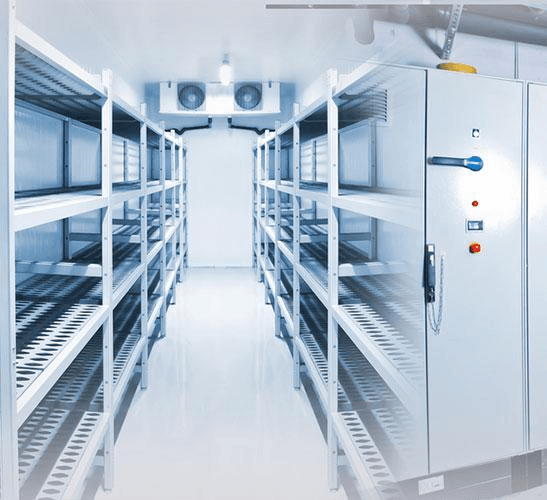
Proper cold storage is perhaps the most direct link between kitchen equipment and food cost control. Ingredients stored at incorrect temperatures spoil faster, increasing your spoilage waste metric and directly adding to your actual food cost. Commercial-grade refrigeration equipment — including undercounter chillers, blast chillers, and walk-in cold rooms — maintains consistent temperatures, extends ingredient shelf life, and protects the value of your inventory. A blast chiller in particular allows you to safely preserve prepared dishes and ingredients across service periods, dramatically reducing over-production waste.
Find the Best Blast Chiller for Your UAE Restaurant Kitchen
Combi Ovens and Yield Optimization
One of the most significant hidden food costs in any UAE restaurant is cooking shrinkage — the weight lost when proteins are cooked. A chicken breast that enters the oven at 180g may come out at 130g depending on cooking method and equipment. A commercial combi oven with precise humidity and temperature control can reduce cooking shrinkage by 15–25% compared to conventional ovens. Over a month of service, this yield improvement across hundreds of covers represents a material reduction in your effective food cost per portion.
Explore Commercial Combi Ovens for Better Yield Control
Food Preparation Equipment and Portion Consistency
Inconsistent portioning is one of the most common contributors to the ideal vs actual cost gap in UAE restaurant kitchens. When a chef cuts a portion by eye rather than by weight, the variance can be 10–20% above or below the standardized portion. Over thousands of portions a month, this variance has a significant financial impact. Professional food preparation equipment — including food slicers, portion scales, and standardized scoops and ladles — removes the guesswork and brings portion costs into alignment with your recipe costing template.
Shop Commercial Food Slicers for Consistent Portioning
Commercial Fryers and Oil Cost Management
Cooking oil is one of the highest-volume consumable ingredients in many UAE restaurant concepts — particularly in casual dining, fast food, and street food formats. Oil degradation rates directly affect both food quality and cost. High-efficiency commercial fryers with built-in filtration systems extend oil life by 30–50% compared to basic fryers, reducing the frequency and cost of oil replacement — a direct reduction in your food cost percentage.
Browse High-Efficiency Commercial Fryers to Reduce Oil Costs
Inventory Management: The Operational Backbone of Food Cost Percentage UAE Restaurant Control
No discussion of food cost percentage UAE restaurant control is complete without addressing inventory management. Your recipe costing template tells you what things should cost. Your waste tracking system tells you where value is being lost. But it is your inventory management process that connects purchasing, storage, and production into a coherent, controllable system.
FIFO: First In, First Out
FIFO is the most fundamental inventory principle in any restaurant kitchen. All new stock deliveries go to the back of the shelf or bottom of the reach-in refrigerator; older stock stays at the front and is used first. This single discipline, consistently applied, virtually eliminates spoilage waste from stock rotation errors. In the UAE’s high-temperature environment, where the ambient temperatures mean cold chain integrity is critical, FIFO is not optional — it is essential.
Par Level Management
A par level is the minimum quantity of an ingredient you need on hand at any given time to run service without running out. Par level management means you order just enough to replenish to par — no more. Over-ordering is the leading cause of spoilage waste in UAE restaurants, particularly for fresh produce, dairy, and proteins. Setting and respecting par levels by ingredient category, calibrated to your actual daily sales volumes, is the simplest way to reduce spoilage without ever touching a recipe or a menu price.
Weekly Physical Stock Counts
Monthly stock counts are not sufficient for active food cost management. Weekly counts — even if simplified to your top 20 highest-cost ingredients — give you real-time visibility into consumption versus purchases and flag discrepancies before they compound into a quarterly problem. When your weekly count reveals that you’ve consumed 30% more olive oil than your recipe cards would predict, you investigate immediately — before that variance has affected three or four weeks of profitability.
View Stainless Steel Storage Equipment for Organized UAE Kitchens
A Step-by-Step Action Plan to Reduce Food Cost Percentage UAE Restaurant in 90 Days
Theory is valuable. Action is essential. Here is a practical 90-day roadmap that any UAE restaurant operator can follow to reduce their food cost percentage UAE restaurant by 3–7 percentage points — without reducing quality or alienating customers.
Days 1–30: Measurement Foundation
- Conduct a full physical stock count and establish opening inventory value.
- Build a recipe costing template for every item on your current menu.
- Calculate your theoretical (ideal) food cost percentage for each dish and overall.
- Pull your actual food cost percentage from the last three months of accounting data.
- Identify your ideal vs actual cost gap and document the primary suspected causes.
- Implement a basic waste log at each kitchen station.
Days 31–60: Procurement and Waste Optimization
- Identify your top 10 highest-cost ingredients by monthly spend.
- Get competitive quotes from at least two alternative suppliers for each.
- Enter supplier price negotiation for your three highest-spend categories.
- Implement FIFO labeling and par level management across all storage areas.
- Review first month of waste log data with the kitchen team and set targets.
- Introduce portion scales at all cooking stations producing high-cost items.
Days 61–90: Menu Engineering and Pricing Review
- Analyze your menu by food cost percentage per dish using your updated recipe costs.
- Identify your top five highest-food-cost-percentage dishes — are they priced correctly?
- Apply menu price adjustment triggers framework — which items need repricing?
- Redesign your menu layout to promote high-margin items more prominently.
- Conduct a full stock count at day 90 and calculate your new actual food cost percentage.
- Compare to your day-one baseline and document the improvement.
Frequently Asked Questions About Food Cost Percentage UAE Restaurant
What is a good food cost percentage for a UAE restaurant?
For most UAE restaurant concepts, a food cost percentage between 28% and 35% is considered healthy. Quick-service restaurants may target 22–28%, while fine dining operations with very high revenue per cover can operate at up to 35–38% if other cost lines are tightly controlled. The right target depends on your concept, price point, labor structure, and rent as a percentage of sales.
How do I calculate food cost percentage for a single dish?
Divide the total ingredient cost of the dish by its selling price, then multiply by 100. For example, if a dish costs AED 22 in ingredients and sells for AED 75, the food cost percentage is 29.3%. Use a recipe costing template to ensure you are capturing every ingredient at its correct portion weight and current purchase price.
What is the ideal vs actual cost gap and how do I close it?
The ideal vs actual cost gap is the difference between your theoretical food cost (based on standardized recipes) and your real food cost (based on actual inventory movements). A gap above 3% indicates problems with portioning, waste, theft, or recipe non-compliance. Close it by implementing portion scales, a waste tracking system, weekly stock counts, and regular recipe compliance checks.
How often should I update my recipe costing template?
Your recipe costing template should be updated whenever supplier prices change for key ingredients — which in the UAE can happen monthly or even more frequently for imports. A formal monthly review of your top 20 ingredients is the minimum recommended frequency. Any time you sign a new supplier contract at different rates, the affected recipes must be updated immediately.
What is a waste tracking system and do I need one?
A waste tracking system is a structured process for recording, categorizing, and quantifying all food waste in your kitchen — from preparation trimmings to spoilage to over-production. Yes, every UAE restaurant needs one. Even a simple paper-based daily waste log at each station delivers measurable results in reducing food cost percentage within the first 60 days of implementation.
How do supplier price negotiations affect food cost percentage?
Supplier price negotiation directly reduces the input cost of your ingredients without requiring any changes to your menu or recipes. A 5–10% reduction in your protein costs — typically the largest single food cost category — can reduce your overall food cost percentage by 1.5–3.5 percentage points. Prepare with competitive quotes, commit to volume, and negotiate payment terms alongside unit prices.
When should I adjust my menu prices in the UAE?
Review menu prices whenever your food cost percentage rises 3 or more percentage points above your target for two consecutive months, when a key ingredient price increases by 15% or more, when a new supply contract is signed at higher rates, or when your menu has not been reviewed in more than six months. Use menu price adjustment triggers as a proactive framework rather than waiting for a financial crisis to force a repricing.
What software do UAE restaurants use for food cost management?
Popular options in the UAE include Foodics (widely used across the Gulf with Arabic-language support), MarketMan, Apicbase, and integrated modules within POS systems like POSRocket. For waste tracking specifically, Winnow and Leanpath have active UAE deployments in hotel and large-format restaurant environments. Many smaller operators begin with well-structured Excel or Google Sheets recipe costing templates before investing in dedicated software.
How does kitchen equipment affect food cost percentage?
Kitchen equipment affects food cost percentage through its impact on yield (cooking shrinkage in ovens and fryers), spoilage prevention (quality of refrigeration), portion consistency (prep equipment and scales), and energy efficiency (which affects the all-in cost of food production). Investing in commercial-grade equipment from reputable suppliers reduces waste and improves consistency — both direct contributors to lower food cost percentage.
Is 40% food cost percentage too high for a UAE restaurant?
For most UAE restaurant concepts, a food cost percentage of 40% or above is a serious financial warning signal. Combined with typical labor and occupancy costs, a 40% food cost leaves very little margin for profitability. The only exceptions are hotel restaurants where food cost is partially subsidized by room revenue, or very high-end fine dining experiences where the menu price per cover is significantly above the UAE average. For all other concepts, investigate and address a 40%+ food cost urgently.
What are the most common causes of high food cost percentage in UAE restaurants?
The most common causes include: lack of standardized recipe costing, no waste tracking system, over-ordering leading to spoilage, passive purchasing with no supplier price negotiation, inconsistent portioning, failure to update menu prices in response to ingredient cost increases, untracked staff meals and complimentaries, and a large ideal vs actual cost gap that is never investigated or closed.
How does Ramadan affect food cost percentage in UAE restaurants?
Ramadan significantly affects UAE restaurant dynamics. Iftar buffet demand spikes, increasing over-production waste risk for buffet-format operators. Suhoor service extends operating hours, changing consumption patterns. Delivery volume typically increases dramatically during Ramadan, benefiting cloud kitchens and delivery-focused concepts. During Ramadan, food cost management requires adjusted par levels, tighter waste tracking of buffet over-production, and repriced Iftar and Suhoor set menus that are costed accurately before they are launched.
Conclusion: Take Control of Your Food Cost Percentage UAE Restaurant Starting Today
Running a profitable restaurant in the UAE is one of the most rewarding and demanding entrepreneurial challenges in the region. The market is vibrant, the customers are discerning, and the competition is fierce. In this environment, the restaurants that survive and thrive are not necessarily those with the most innovative menus or the highest Instagram engagement — they are the ones that build financial discipline into the fabric of daily kitchen operations.
Controlling your food cost percentage UAE restaurant is not a one-time project. It is an ongoing discipline that demands consistent measurement, honest analysis, proactive supplier relationships, and a kitchen team that understands the financial stakes of every gram they trim, every portion they plate, and every batch they over-produce. The frameworks covered in this guide — recipe costing templates, waste tracking systems, supplier price negotiation, ideal vs actual cost gap analysis, and menu price adjustment triggers — are not theoretical concepts. They are the operational tools that profitable UAE restaurant operators use every single month to protect their margins.
Start with measurement. If you don’t know your current food cost percentage, calculate it this week. Build your first recipe costing template for your top 10 selling dishes. Start a waste log at your busiest station. Get a competing quote on your highest-spend ingredient. Each of these steps takes less than a day, and each one moves the needle on your food cost percentage UAE restaurant performance.
If you found this guide valuable, share it with a fellow restaurant operator, leave a comment with your biggest food cost challenge, or explore related resources on menu engineering, kitchen management, and commercial kitchen equipment selection on our website. The tools, equipment, and knowledge to run a leaner, more profitable UAE restaurant are all within reach.